
AI
•
September 2023
June 2026
The Edge Computing Paradox: Maybe Your Data’s Safest Place Isn’t the Cloud
Everyone talks about cloud analytics. It makes sense. The cloud is where dashboards live, where teams compare trends, where data gets turned into reports, alerts, and business decisions. It’s flexible, scalable, and easy to access from anywhere. But there’s a quieter, more counter-intuitive idea worth paying attention to: What if the safest place for your data is the equipment on-site, not someone else’s server?
The edge computing paradox.
For years, “smarter” systems have often meant sending more data to the cloud. More video. More logs. More activity. More metadata. The assumption is simple: if you want better insights, move the data to a system powerful enough to process it. But local processing flips that thinking.
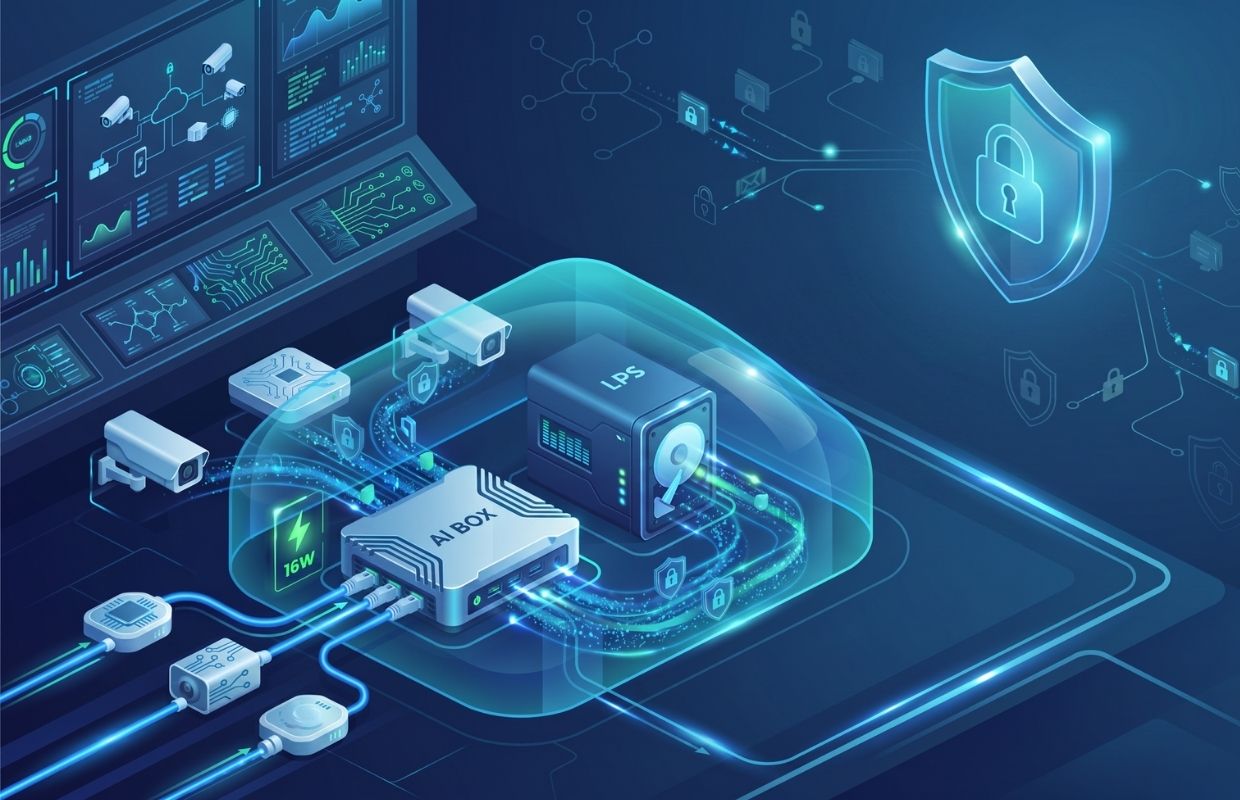
Instead of pushing everything off-site, edge devices can process and analyze critical data right where it’s captured. With local recording via LPS and low-power operation at around 16W, the system doesn’t need to rely on constant cloud transfer to be useful.
When data stays on-site, there’s less exposure. Fewer handoffs. Fewer external systems involved. Fewer moments where sensitive information has to travel across networks or sit on infrastructure you don’t fully control.
Edge storage aligns with broader edge computing guidance: processing data closer to where it’s generated can reduce latency, lower bandwidth demands, and limit the amount of data that needs to move across networks. [1][2]
The cloud can still play a role. But it doesn’t have to be the first stop for everything.
Where the Ganz AI Box Fits In
This is where a solution like the Ganz AI Box V2.0 becomes interesting.
The Ganz AI Box is a new-generation, AI-based intelligent video analytics solution that works as an extension for existing camera systems. Instead of requiring a full rip-and-replace, it can be installed and integrated into current video surveillance environments. [6]
That makes it a practical edge-computing bridge: it brings AI video analytics closer to the camera system without forcing every insight to start in the cloud.
The AI Box supports features such as deep-learning video analytics, event rule combining, smart scene detection, high-performance pose estimation, and multi-level AI-based false-alarm reduction. It can also run multiple AI apps on each video channel, with web-based configuration and compatibility with ONVIF and REST API integrations. [6]
Rather than sending all video data for analysis, the system can provide intelligent detection and filtering closer to the point of video generation. This approach allows teams to focus on significant events, reduces unnecessary alerts, and keeps more processing local.
The Less Obvious Security Advantage
Local processing is especially interesting because it feels almost old-school at first. Recording on-site? Processing locally? Lower power consumption? It doesn’t sound as flashy as big cloud platforms and AI-powered analytics dashboards.
Smart architecture sometimes means sending less data. Security can be improved by reducing the distance data must travel.
A 16W local system doing meaningful processing on-site changes the equation. It can support continuous operation without creating unnecessary dependence on bandwidth, remote infrastructure, or cloud availability. If the external network drops, the equipment doesn’t suddenly become useless. If data doesn’t need to leave the site, it doesn’t create the same risk profile.
The Ganz AI Box fits into that same idea: bring intelligence closer to the source, integrate with existing systems, and reduce the need to treat the cloud as the default destination for every piece of video data.
Edge computing may seem less futuristic, but it could be the more practical choice. When cloud?” A better question might be: Does this data need to leave the site?
In some cases, the answer is yes, as centralized analytics, multi-location visibility, and long-term reporting can benefit from cloud tools.
But for local recording, immediate processing, and sensitive operational video data, on-site equipment can be more than enough. In some cases, it may be safer, simpler, and more resilient.
Edge computing doesn’t reject the cloud. It just challenges the assumption that the cloud should handle everything.
And solutions like the Ganz AI Box make that shift more realistic.
They give organizations a way to add AI analytics to existing surveillance systems, process more intelligence locally, reduce false alarms, and keep critical video workflows closer to where the data is created.
The safest data strategy may not be about choosing cloud or edge. It may be about knowing what belongs where. Because sometimes, the best place for your data is exactly where it already is.
For more information about the AI Box or to request a demo, go to https://ganzsecurity.com/aibox.
Sources
- https://www.ibm.com/topics/edge-computing
- https://azure.microsoft.com/en-us/resources/cloud-computing-3 3 dictionary/what-is-edge-computing
- https://nvlpubs.nist.gov/nistpubs/Legacy/SP/nistspecialpublication800-145.pdf
- https://cloudsecurityalliance.org/research/guidance
- https://www.ganzsecurity.com/series/aibox
.jpg)

.png)