

Sustainability
•
December 2025
December 2025
4 Unexpected Ways Your Security System Can Reduce Your Carbon Footprint
Security systems have always been the forgotten cost center—necessary but expensive, constantly draining power without creating value. That's changing. Edge AI and IoT are transforming surveillance into something unexpected: a powerful weapon against carbon emissions.
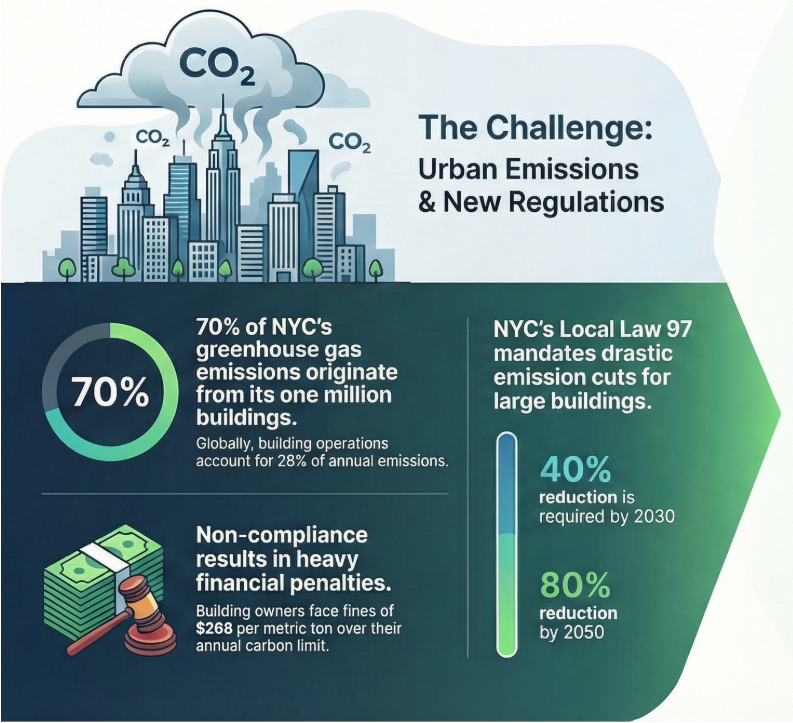
The technological shift is arriving just in time. For building owners facing stringent environmental regulations, finding efficiencies in every system is critical. A prime example is New York City's Climate Mobilization Act, or Local Law 97, which impacts about 50,000 buildings and mandates that they cut carbon emissions by 40% by 2030 and 80% by 2050. This legislation is a bellwether for similar laws expected in other major cities, seeking innovative, sustainable solutions that are an urgent global priority.
1. AI's Surprising Climate Job: Eliminating 'False Alarm' Emissions
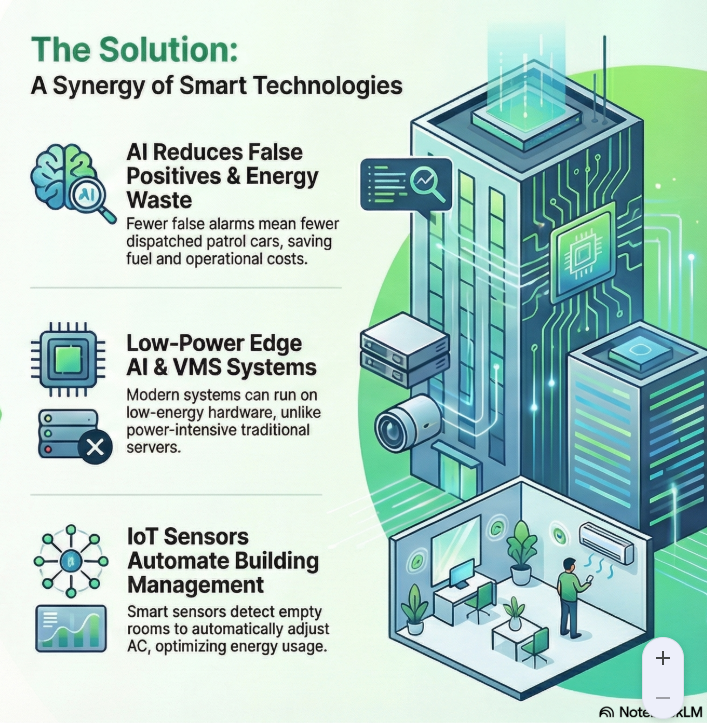
In security, a "false positive" is an alert triggered by a non-threatening event—think of a bird flying past a door versus a person approaching it. Traditionally, these false alarms have a direct, wasteful environmental impact by triggering unnecessary deployments of resources, most notably security patrol cars.
Fuel is consumed, and vehicle emissions are released each time a guard drives to investigate a false alarm. This impact isn't limited to cars; it applies to any motorized transport, from Segways to electric bicycles. Here, AI acts as a sophisticated filter, distinguishing genuine threats from ambient noise, ensuring resources are deployed only when genuinely needed. AI can prevent the wasteful cycle of false alarms and their associated emissions.
The cumulative effect is significant. For a large campus, eliminating just 10 false alarms per week could be the emissions equivalent of taking a passenger car off the road for a month.
2. It's How You Process, Not Just What You Record
A Video Management System (VMS) is the heart of any surveillance operation, but not all are created equal. Traditional systems often rely on simple motion-based recording, an approach that captures vast amounts of unnecessary footage and requires significant server resources, storage capacity, and power to manage.
Modern systems like the Ganz CORTROL VMS take a more innovative approach. By handling standard video streams such as H.264 and H.265 in their original format, the system avoids the need for power-hungry re-encoding. This simple feature drastically reduces server workload, allowing them to run on less powerful CPUs that consume far less energy.
This efficiency is so profound that users can deploy a complete VMS on a "PC stick"—a device barely larger than a flash drive. This approach shrinks the physical and energy footprint of a security hub from a server rack to a coat pocket.
3. Retrofit, Don't Replace: The Power of a Low-Wattage AI 'Brain.
Upgrading an entire camera network to be "smarter" often seems like a monumentally wasteful task, creating e-waste and incurring massive costs. A more sustainable solution is to retrofit existing infrastructure with a low-power edge appliance, like the Ganz AI Box, which adds advanced AI capabilities to existing camera systems.
Consuming only 16 watts, this device is exceptionally energy efficient. The strategic advantage here is twofold: avoiding the immense e-waste of a complete hardware replacement while still gaining cutting-edge analytics. Instead of replacing numerous cameras, a single Ganz AI Box can upgrade eight channels to up to 4K resolution or 16 channels to 1080p.
When this low-wattage AI "brain" is paired with the low-processing-power Ganz CORTROL VMS, the result is a compound effect on energy reduction, creating a complete, hyper-efficient surveillance ecosystem.
4. Connecting the Dots: From Empty Rooms to Emission Mandates
The true power of a modern security platform lies in its ability to serve as a central hub for building intelligence. By integrating smart IoT sensors that can detect environmental factors like poor air quality, carbon dioxide, and nitrous oxide, building operators can create an automated system that actively manages and reduces energy consumption.
Consider a common scenario: an IoT sensor detects that the air conditioning is running in an empty conference room. That sensor sends an alert to the Ganz CORTROL Global VMS. The VMS's "Event and Action Manager" then automatically triggers a pre-programmed action, such as turning off the AC unit, preventing energy waste without requiring manual intervention.
For building owners, this capability is a vital tool for compliance. It provides the data and automation needed to monitor and reduce energy consumption, helping them meet the strict targets set by regulations like NYC's Local Law 97 and avoid substantial fines. As noted by urban policy experts, this kind of regulation is changing the game for property owners worldwide.
Observers have called the law "one of the most ambitious climate legislations for buildings enacted by any city in the world."
A Smarter, Greener Future
The evolution of modern security systems demonstrates a critical shift in infrastructure design: single-purpose systems are becoming multifunctional, data-driven assets essential to urban sustainability. No longer just passive energy consumers, these platforms have evolved into active participants in the mission to reduce our collective carbon footprint, from eliminating wasteful vehicle deployments to intelligently managing building automation.
This transition demonstrates that with the right technology, even the most established systems can be reimagined for a more efficient and responsible future. Now that your security system can help manage your carbon footprint, what other single-purpose systems are ready to take on smarter, more sustainable roles?
Sources:
- https://architecture2030.org/achieving-80x50-nyc/
- https://www.urbangreencouncil.org/content/projects/all-about-local-law-97
- https://www.iotforall.com/could-sensor-technology-be-the-answer-to-nyc-climate-mobilization-act-targets
- https://www.youtube.com/watch?v=jSg8AI9mt3I
- https://www.ganzsecurity.com/blog/smart-cities-today-using-tomorrows-security-technology
- https://www.ganzsecurity.com/blog/harnessing-ai-for-a-greener-more-secure-future


